
May 07, 2026 | 11 minute read
In most cases, modern implants last 10–20 years or longer, depending on a variety of factors. Some people go decades without any issues, while others may need a breast implant revision or replacement significantly sooner. If you’re thinking about breast augmentation, you know that it’s a worthy investment in your appearance and your confidence. However, what you may not know is that breast implants aren’t designed to be lifetime devices, so there may come a time when they need to be replaced. In this blog, we’ll explore what affects the lifespan of your breast implants, as well as what to watch for and how to know when you may need to consider replacement.
Factors Affecting the “Lifespan” of Breast Implants
Several factors influence how long your breast implants will last, and no two patients will have the exact same experience. If you go on the internet and search “How often will I have to get my breast implants replaced?,” the simple answer you’ll get is roughly every 15 years.
Now this doesn’t mean that you have to make an appointment with your plastic surgeon 15 years to the day after your implants were placed to get them replaced. And while breast implants don’t need to be replaced on a set schedule, there are situations where breast implant revision surgery becomes necessary or desirable. These situations arise because of implant factors, patient factors, or both.
Implant Factors
When we say “implant factors,” we are talking about issues that arise with the breast implants themselves. Breast implants are devices—not very sophisticated devices, but devices nonetheless. If left in long enough, these devices will eventually start to develop problems of their own, largely independent of the body.
Capsular Contracture
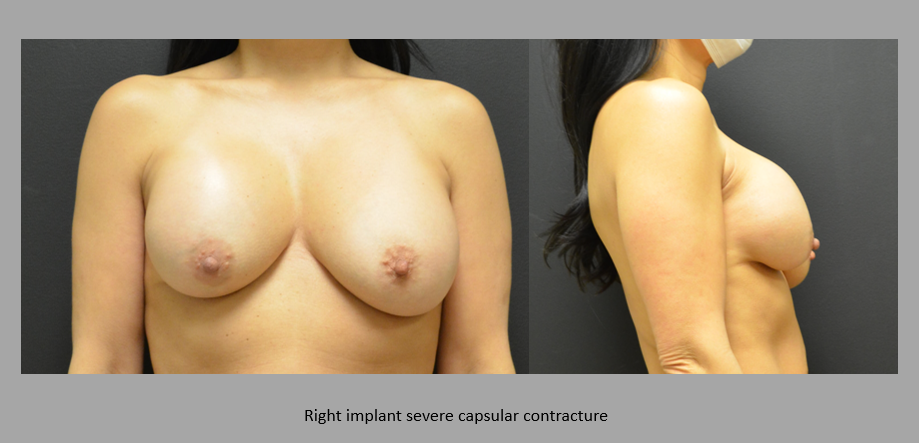
I always tell patients that anytime you put something foreign in the body, whether it’s a plate on a broken bone, a knee replacement, or a breast implant, the body forms a scar around that foreign body. Think of it as your body’s way of saying, “This isn’t part of me, and I’m going to wall it off from the rest of the body”. In the case of a breast implant, this scar is called a capsule. Over time, this capsule may squeeze down on the implant. This is called capsular contracture.
Capsular contracture is not an all-or-none phenomenon. It’s a spectrum of severity that can range from mild hardening and distortion of the implant to pushing the implant out of position and causing discomfort (see picture below). If you want to learn more about capsular contracture, I’ve written an entire blog here, but for the purposes of this blog, all you need to know is that capsular contracture may cause the implants to look distorted and, in severe cases, may even cause pain. In these scenarios, patients will often seek revisions to their breast implants.
Rupture
Advances in breast implant technology have significantly improved their durability and longevity, making newer implants more resilient than older generations. That being said, a common reason patients seek revisions to their breast implants is rupture. To understand implant rupture, it’s first necessary to understand that there are two types of breast implants: saline and silicone.
The rupture rate for both types of implants is roughly 1% per year, with saline ruptures slightly more common. This means that 10 years after they’ve been placed, 90% of all breast implants are intact. After 10 years, however, implant shells (the material that holds the shape of the silicone or saline) slowly start to break down, and the rupture rate doubles every five years thereafter:
| Number of Years Since the Implant(s) Were Placed | Rupture Rate |
| 10 | ~10% |
| 15 | ~20% |
| 20 | ~40% |
| 25 | ~80% |
While implant rupture is relatively rare (before 15 years), it can look very different for saline and silicone implants.
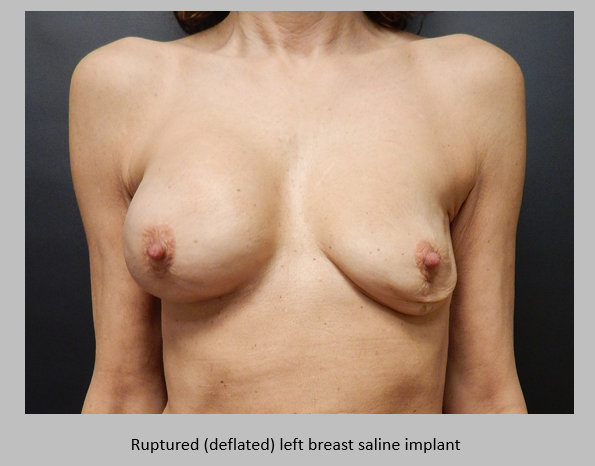
Saline implants are simply salt water inside a silicone shell. These implant shells are placed under the breast empty, and then filled with salt water through a small hose attached to the implant via a special fill valve, all while the patient is asleep. Because of this, saline implant rupture:
- Happens because of a hole in the implant shell or a failure of the fill valve
- Tends to present with a sudden loss of volume (like a flat tire); patients will often say their implants deflated “overnight” (see photo below)
- Is slightly more common than silicone rupture
- Requires surgery to fix
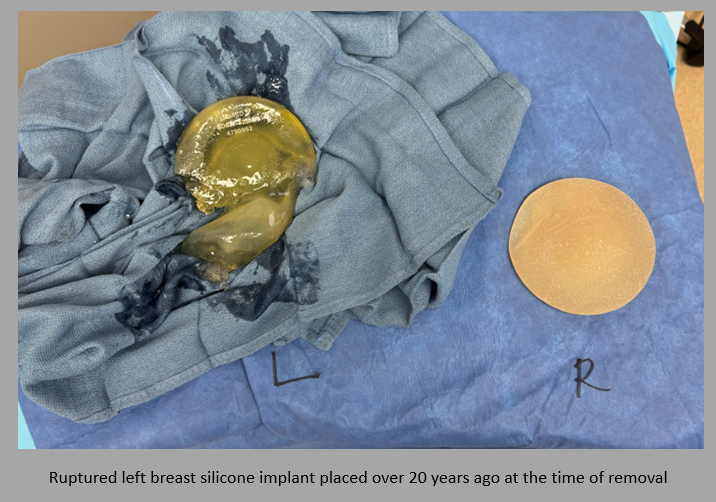
Silicone implants are made of a silicone shell filled with, you guessed it, silicone—a very sticky gel with a consistency like jello. The history of silicone implants is a whole separate topic, but it’s important to know that silicone implants have changed dramatically over the roughly 60 years since they were first introduced. Silicone implants from the 1960s–1980s were filled with a liquid silicone, so if you cut them, the silicone would spill out all over the floor, or into the body (see photo below).
For the last several decades, however, silicone implants have been made with what’s called a cohesive gel that is not liquid—think of pulling a gummy bear in half (hence the term “gummy bear” implant). Since the gel is what we plastic surgeons call “form stable,” it doesn’t leak or liquify the way old silicone implants used to. Silicone implants come pre-packed and are inserted under the breast fully filled. For these reasons, silicone implant rupture:
- Happens only when the implant shell develops a hole
- Often goes unnoticed because the gel doesn’t leak out of the shell the way saline does (called a “silent rupture”)
- May result in slow changes in the breast shape over time (months to years)
- Usually requires medical imaging (MRI or Ultrasound) to diagnose
- Often presents as capsular contracture
- Requires surgery to fix
Malposition
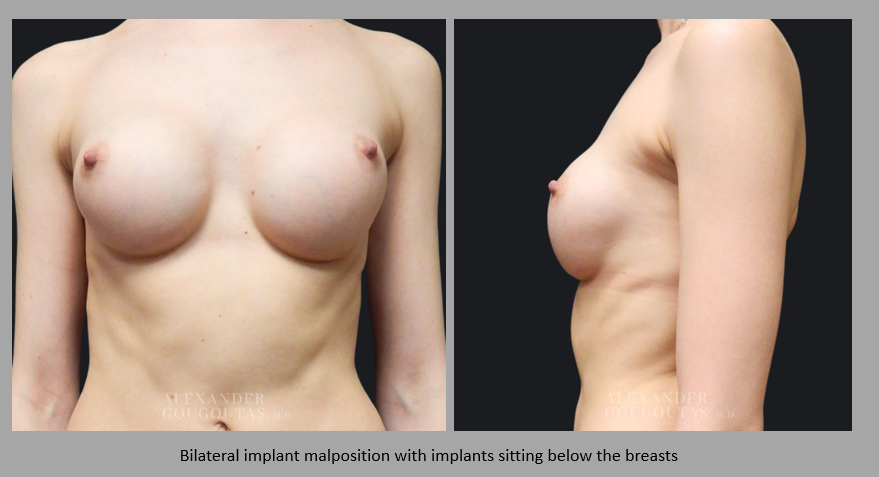
Malposition is the plastic surgery term for “out of position.” In other words, the implant slips out from beneath the breast tissue and/or muscle. When this happens, it tends to occur below the breast (called “bottoming out” of the implant) or to the side. Bottoming out tends to be more distressing to patients because it is noticeable all the time, whereas when the implant(s) fall out to the side, it tends to only be noticeable when patients lie on their backs.
Malposition:
- Usually happens slowly over many months to years
- Can range in severity from mild to severe
- Develops when the pocket the implant sits in under the breast becomes bigger than the implant itself
- Usually causes a loss of volume in the upper part of the breast
- Requires surgery to fix
Patient Factors
What we mean by “patient factors” are changes in the breasts themselves that happen independent of the implant. If breast implants are left in long enough, the body will change over the implants. While the implants themselves may be perfectly fine, the bodily changes around the implant may lead to undesirable results and can often drive people to get a revision to their implants.
Weight Fluctuations
Weight fluctuations may cause a change in the appearance of breast implants. With even moderate weight fluctuations, implants may lose their definition and shape as the tissue over the implants thickens and the skin stretches. With large weight fluctuations, implant malposition may even develop over time.
Pregnancy / Breastfeeding
Pregnancy and/or breastfeeding tend to result in weight fluctuations, which we’ve addressed above. Specific changes to the breasts themselves during pregnancy and/or breastfeeding make these situations unique—changes may include rapid enlargement of the breasts followed by loss of volume, loss of breast density, and increased sagging of the breasts.
Natural Aging
While plastic surgery can turn back the aging clock, it can’t stop it. I often see patients who have implants that appear perfect—without rupture, malposition, or capsular contracture—who are unhappy with the appearance of their implants. This is almost always a result of the patient’s native breast tissue aging around or over the implants themselves. The classic example of this is the waterfall deformity, which I’ve previously described in detail. In this scenario, I tell patients that their implants and breasts “aren’t talking” to each other, and surgery is always required in order to re-establish this critical communication.
Lifestyle
In the ultimate injustice, patients with very active lifestyles may experience implant changes sooner than those who are more sedentary. The take-home message here is NOT to be a couch potato in order to protect your breast implants, but rather to understand that certain repetitive, high-impact activities may lead to implant malposition over time.
Personal Preferences
People’s preferences change over time. Enough said. I often see patients seeking revision to their breast implants because they want to upsize, downsize, or remove them altogether.
Signs Your Breast Implants Need to Be Replaced
Your body usually gives you clues when your breast implants need to be replaced, or at least evaluated to ensure everything is as it should be. Signs your breast implants need replacing include:
- Visible changes in breast shape or symmetry
- A sudden decrease in size, especially with saline implants
- Increased firmness, tightness, or discomfort in one or both breasts
- Persistent swelling
- Lumps or unusual contours
- Changes in how the implant feels
- General dissatisfaction
As mentioned above, if you have silicone implants, changes can be subtle. If anything about your implants seems different, it’s worth having it checked—even if it turns out to be minor.
How to Monitor Your Breast Implants
Breast implants aren’t something that you should forget about once the surgery is complete. They require ongoing monitoring and care. Some tips to remember to extend the longevity of your breast implants include:
- Getting familiar with how your breasts look and feel so you can quickly notice any changes
- Following up with your surgeon, especially in the first year after your breast augmentation and periodically afterward
- If you have silicone implants, undergoing routine imaging to screen for silent rupture, which typically involves getting an MRI or ultrasound starting five to six years after your breast augmentation and every two to three years thereafter
FAQs
1. Should a rupture in my breast implant(s) be considered an emergency?
The short answer to this is no. If you develop a hole in your saline implant, your body will absorb the harmless saline. If you develop a hole in your silicone implant, what happens largely depends on the age of your implants. The silicone will likely be contained by the surrounding capsule. In severe cases, it may “leak” beyond the capsule.
In either case, changes to the surrounding breast tissue will eventually occur, which may make future revisions more challenging. As a rule of thumb, implant rupture, whether saline or silicone, is never an emergency, but should be evaluated as soon as possible.
2. Is there anything I can do to maximize the longevity of my breast implants?
Again, the short answer is no. Maintain a healthy lifestyle, get regular mammograms, and seek a consultation with a plastic surgeon should you have concerns or changes with your breast implants.
3. Can mammograms cause my breast implants to rupture?
While mammograms can cause rupture to old implants, particularly with brittle, calcified capsules, it is exceedingly rare. Though studies are lacking, the likelihood of breast implant rupture as a result of mammograms has been estimated at 0.01% (one hundredth of 1%). To put this in perspective, a woman is more than 10 times more likely to develop breast cancer (0.125%) over the course of her life than to get a rupture in one of her breast implants as a result of a mammogram.
4. Will my routine mammogram detect a rupture in my breast implants?
While mammograms can detect silicone implant rupture in cases of severe rupture, they are not ideal for less severe cases. If you suspect a rupture in your silicone implant, schedule a consultation with your plastic surgeon, who will then order the correct imaging test if necessary.
5. If I develop capsular contracture, does it mean I have to have surgery to fix it?
If capsular contracture develops and is detected early, some over-the-counter medications have been shown to slow the process or even reverse it in rare cases. Advanced capsular contracture, however, always requires surgical correction.
Learn More About Breast Implant Replacement in Seattle
Breast implants are an excellent option for gorgeous, long-lasting enhancement, but they’re not meant to last forever. However, with the right surgeon and proper care, you can enjoy your results for many years. To learn more about breast rejuvenation procedures in Seattle, schedule a consultation with board-certified plastic surgeon Dr. Alexander Gougoutas today by calling (206) 320-6138 or completing the online contact form.