
July 13, 2026 | 8 minute read

As patients with breast implants will attest, the benefits of breast augmentation are immediate and profound. These include increased confidence, enhanced feminine contours, and improvement in the ways your clothes fit.
Breast implants, however, are not meant to be permanent devices. One of the most common questions I get as a plastic surgeon is “How often do I need to get my implants replaced?” The answer to this question is unique to each patient, and it involves a variety of factors.
If you are considering breast implants, you must be educated on their typical lifespan and what factors may make a surgical revision necessary or desirable. This blog discusses one of the most common reasons patients seek breast implant revision surgery: capsular contracture.
Table of Contents
- What Is Capsular Contracture?
- What Causes Capsular Contracture?
- When Does Capsular Contracture Develop?
- How Is Capsular Contracture Treated?
- Capsular Contracture FAQs
What Is Capsular Contracture?
I always tell my breast augmentation patients that any time you put something “foreign” in the body, whether it’s a plate on a broken bone, a knee replacement, or a breast implant, the body surrounds that foreign body with scar tissue. In the case of a breast implant, we call this scar a capsule.
Everyone who has implants forms scar tissue capsules, and it’s a completely natural response to the implant. In most cases, the capsule will remain soft for as long as the existing breast implants are present. In rarer cases, however, capsular contracture occurs when the capsule starts to squeeze down on the implant. Think of the capsule giving the implant a giant bear hug. We call this capsular contracture.
Capsular contracture is not an all-or-none phenomenon. Like most things in plastic surgery, we apply a grading system to your condition according to the severity of capsular contracture:
- Grade 1: No evidence of capsular contracture (It doesn’t make a lot of sense, but I’m only the messenger).
- Grade 2: Nothing that can be seen externally, but the implant starts to feel firmer to the touch.
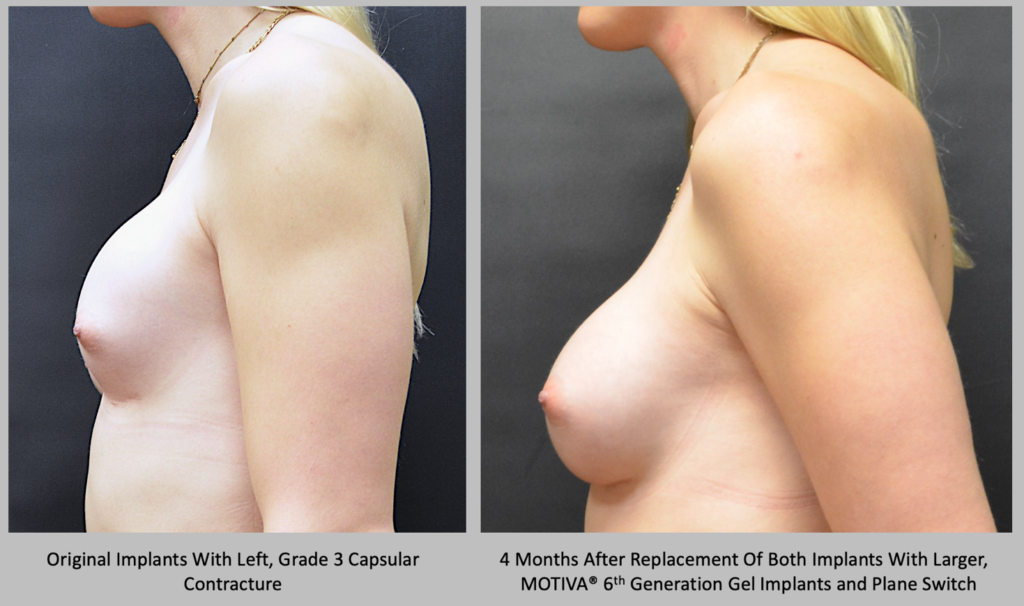
- Grade 3: The capsule squeezes down on the implant, causing it to feel firmer and become displaced from its normal position (usually, it gets pushed up towards the collar bone). A loss of lower pole breast volume is also typically seen. A left grade three capsular contracture is illustrated below:
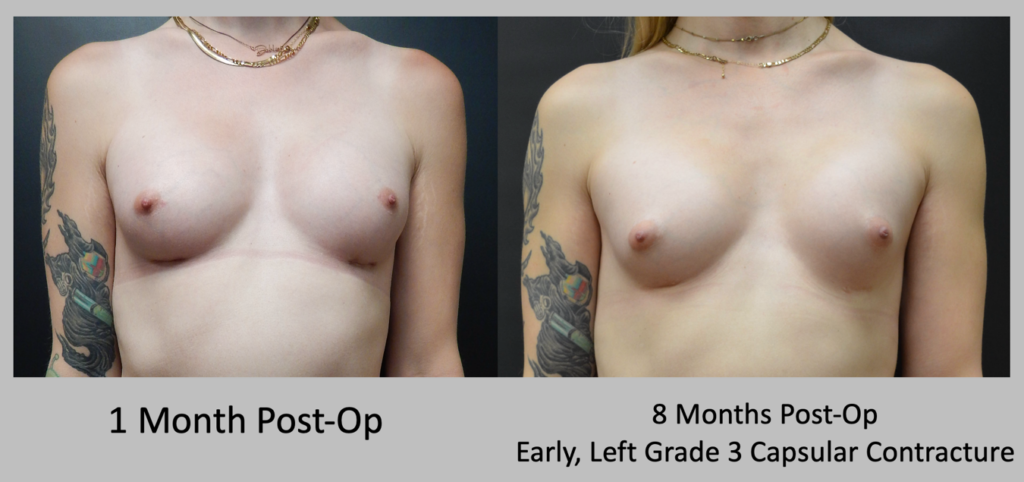
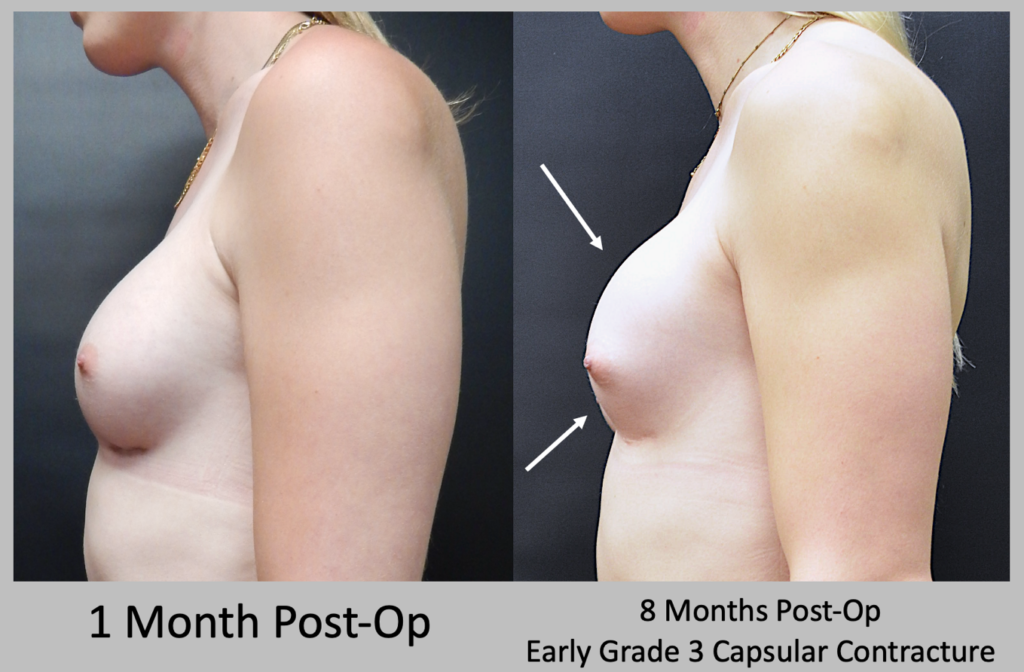
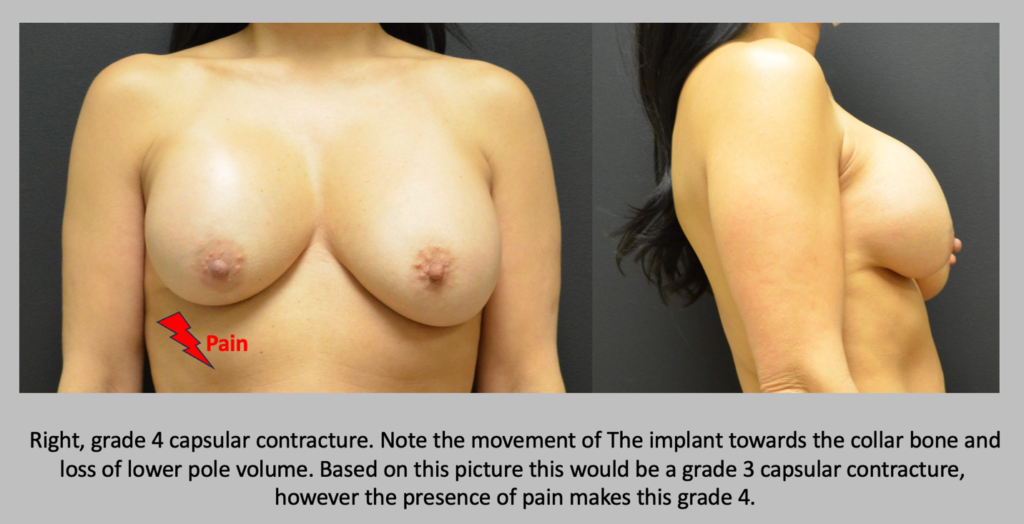
- Grade 4: It displays the same qualities as grade three capsular contracture, but it also causes physical discomfort. This discomfort can range from a mild, intermittent burning sensation to a persistent sensation of tightness that may even limit range of motion. An example of grade four capsular contracture is shown below:
What Causes Capsular Contracture?
While direct causes for capsular contracture are still highly debated, the leading theory on why it happens is because of something called “biofilm.”
Biofilm refers to contamination of the patient’s breast implant surface with bacteria. This happens either during insertion of the implant or after insertion when the implant is exposed to the bacteria-rich network of milk ducts within the breast. The bacterial contamination itself isn’t enough to cause an infection, but it does cause chronic inflammation of the capsule, eventually leading to capsular contracture.
While we may not know what exactly causes capsular contracture, we know of many factors that increase the risk of developing it. These risks include:
Post-Operative Fluid Collections
Patients who experience a blood clot collection (hematoma) or a plasma/lymphatic collection (seroma) after their breast augmentation surgery are at a higher risk of capsular contracture.
History of Capsular Contracture
Women with a prior breast augmentation who’ve experienced capsular contracture are at increased risk of capsular contracture following future augmentation revisions.
Implant Rupture
Older generation silicone implants that rupture may eventually lead to capsular contracture. This presumably is due to scar tissue formation around the older, more liquified silicone.
History of Radiation Therapy
Patients with a history of breast or chest wall radiation, no matter how distant, are at increased risk of developing capsular contracture.
Subglandular Plane of Breast Augmentation
Implants placed directly behind the breast tissue in the “sub-glandular” plane have been shown in several studies to have an increased risk of developing capsular contracture.
Active Nicotine Consumption
Studies suggest that active nicotine consumption, in any form, increases the risk of capsular contracture. This is presumably due to reduced blood flow to the capsule as a result of nicotine effects on the blood vessels.
Medical History
Some studies demonstrate that a history of aggressive, poor scarring or autoimmune diseases places you at increased risk of capsular contracture.
Genetics
Genetic predisposition is sort of a catch-all risk that we use to explain things we don’t really know how to explain. Though there has been no identified gene associated with capsular contracture, there are patients who seem to be strong capsule formers for reasons we can’t otherwise explain. These patients tend to develop recurrent capsular contracture despite numerous surgical revisions to treat it.
When Does Capsular Contracture Develop?
The vast majority (75%) of capsular contractures develop within the first one to two years after breast implant surgery. However, this doesn’t mean that your risk of developing capsular contracture is minimized after 2 years. A minor subset of patients develop capsular contracture many, many years after their initial breast implant surgery.
How Is Capsular Contracture Treated?
This is a complicated question, because treating a capsular contracture depends on many factors that are specific to each patient.
In general, very early capsular contractures (Grade 2) may be treated non-surgically with over-the-counter allergy medications (e.g., Singulair®) and consistent implant massage. It is believed that capsular contracture is driven by the body’s immune response similar to allergies, which likely explains why these medications work.
More advanced grade three and four capsular contractures require surgery to fix. Though the specific surgical techniques used are beyond the scope of this blog, they most often involve a combination of:
- Implant Replacement: The existing, older implants are replaced with new implants specifically designed to reduce the risk of capsular contracture (e.g., textured surface implants or 6th generation MOTIVA® gel implants).
- Capsulectomy: Removing all or most of the existing contracted capsule.
- Plane Switch: New implants are placed in a different plane of augmentation (e.g., sub-pectoral vs. sub-fascial vs. sub-glandular) that has never been in contact with the original implants.
- Tissue Substitutes: These products look like a small piece of leather and are typically manufactured from either human tissue (Alloderm®) or animal tissue (Stratice®). It is believed that these products break up the forces responsible for capsular contracture. Use of these products is often a last resort, given their prohibitive cost.
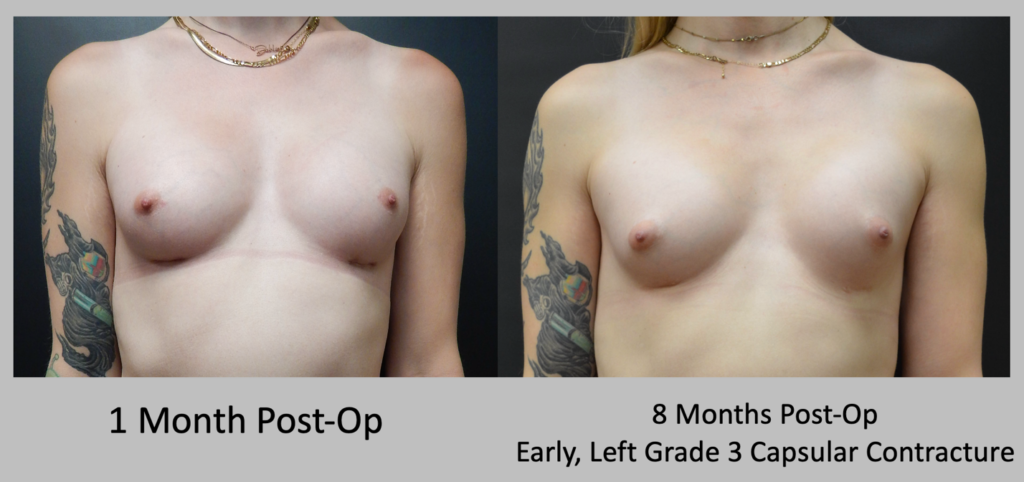
As an example, the patient shown below is the same patient shown above with left grade 3 capsular contracture after revision. The revision included removal of the old implants, a place switch, and implant replacement with MOTIVA® 6th generation gel implants.
Capsular Contracture FAQs
What is my risk of developing capsular contracture over the lifetime of my implants?
Since there are so many patient-specific and implant-specific considerations, there is no single answer. In general, I tell patients their risk of capsular contracture is around one percent a year, or approximately five to 15 percent over the lifetime of their implants.
Is capsular contracture harmful to me?
While capsular contracture can be distressing, unsightly, and even uncomfortable in severe cases, it is never harmful to your body.
Does Capsular contracture ever improve on its own?
Unfortunately, once capsular contracture develops, it never reverses on its own.
Does capsular contracture always get worse once it starts?
Thankfully, no. Just because someone develops an early grade capsular contracture doesn’t mean that it will necessarily progress into a more severe grade over time.
Is there anything I can do to prevent capsular contracture?
Performing self-implant exams is critical to detect any change in feel or texture. If you suspect that one implant may be hardening, notify our team immediately, as early intervention may halt progression.
Do I have to treat or correct capsular contracture?
No. Capsular contracture of any grade does not have to be treated. That being said, in more advanced grades of capsular contracture, underlying causes need to be ruled out. In my observation, patients with very early grade two capsular contracture typically elect to try medical management, as there is minimal risk or side effects of the medications used. Patients with more significant grade three capsular contracture should have their silicone implants evaluated for rupture, as this may be an underlying cause of the contracture. Patients with grade four capsular contracture are most troubled by the physical discomfort and are therefore likely to pursue surgical revision.
Learn More About Breast Implant Options and Capsular Contracture in Seattle, WA
Whether you’re struggling with capsular contracture or still considering breast implants, you need an experienced surgeon with an extensive understanding of breast anatomy to tailor your treatment to your needs. For patients seeking guidance on breast implants and/or capsular contracture in Seattle, WA, board-certified plastic surgeon Dr. Alexander Gougoutas can help you achieve the breast contour and fullness you desire while upholding a safe, comfortable patient environment.
To learn more about breast implants and capsular contracture today, schedule your personalized consultation with Dr. Gougoutas by calling (206) 320-6138 or completing the online contact form.