September 15, 2026 | 13 minute read
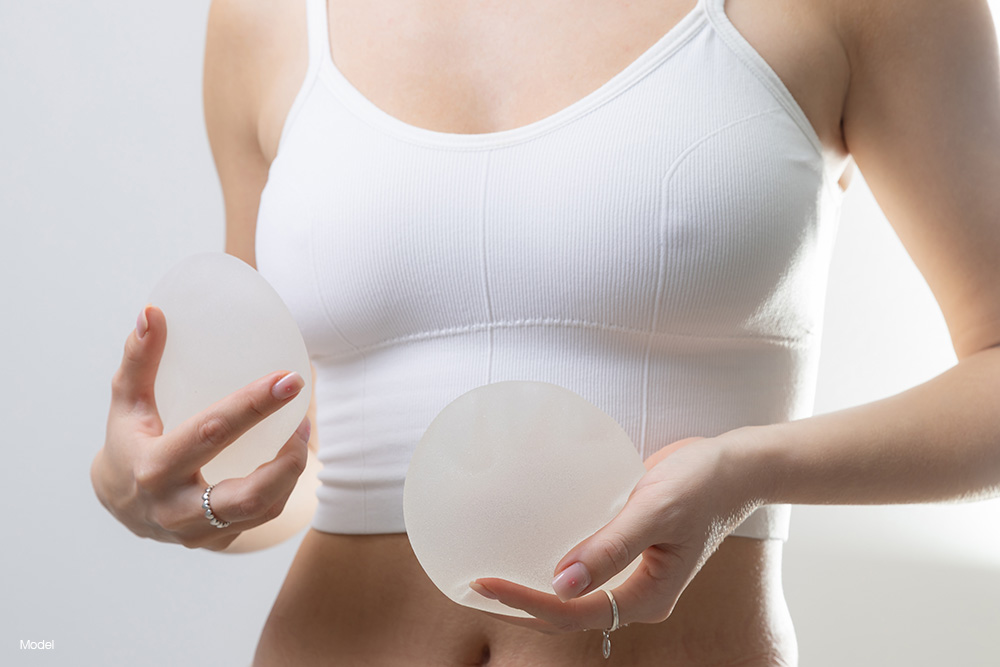
It is estimated that over 800,000 cosmetic breast implants are placed each year in the United States alone. This number increases to over 1 million when including the number of implant-based breast reconstructions performed each year.
If you are considering breast implants for either a cosmetic breast augmentation or reconstructive breast procedure, understanding risks associated with these devices is absolutely critical and should be a fundamental component of any surgical consultation. In the following blog, I will discuss the safety of modern breast implants. I hope that, after reading this blog, you will feel better informed about these incredibly popular devices.
Table of Contents
- Breast Implant Options
- General Implant Risks
- Breast Implant-Associated Anaplastic Large Cell Lymphoma (BIA-ALCL)
- Breast Implant-Associated Squamous Cell Carcinoma (BIA-SCC)
- Breast Implants and Auto-Immune Diseases
- Breast Implant Illness (BII)
- Summary
- Breast Implant Safety FAQs
Breast Implant Options
Saline vs. Silicone
There are thousands of different breast implants available in the United States. While this number sounds overwhelming, understanding the fundamental differences between these implants is actually quite manageable. Below is a chart designed to help.
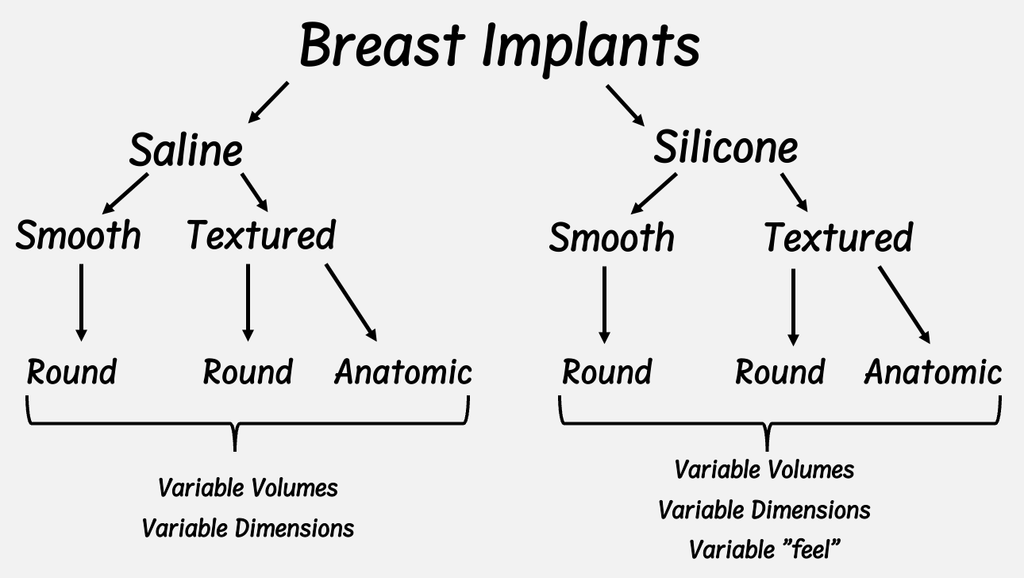
All breast implants are either saline or silicone. What is important to remember is that the “shell” of the implant, namely the casing that keeps the silicone or saline contained, is made of silicone in both cases.
So, a silicone shell is in contact with the body in both saline and silicone implants.
Saline
- The implant comes deflated and is inserted under the breast. It’s then filled with adjustable volumes of sterile salt water (saline) in the operating room.
Silicone
- Each implant comes pre-packed with a different volume of cohesive silicone gel.
- Implants are inserted in the operating room and cannot be adjusted.
Smooth vs. Textured
All saline and silicone implants are either smooth or textured. This distinction has nothing to do with what’s in the implant but rather the silicone shell.
Smooth
- The implant shell has a smooth, shiny surface, similar to glass.
- The smooth surface allows the implant to glide slightly within the implant pocket.
Textured
- The implant shell has a rough surface, like fine sandpaper.
- The textured surface locks the implant into position with little to no movement within the implant pocket.
Round vs. Anatomic
All saline and silicone implants are either smooth or textured. Again, this distinction depends on the silicone shell, not what’s inside the implant.
Round
- The implant base is a perfect circle.
- Round implants can spin within the implant pocket without any consequence.
Anatomic
- The implant base is not round. Instead, it has a more “tear-dropped” shape, providing more volume in the bottom half of the implant that gradually tapers toward the top of the implant.
- Anatomic implants have a very specific orientation when placed in the implant pocket. No spinning is tolerated, as it will misshape the breast.
Other Variables
After implants have been characterized as either saline or silicone, smooth or textured, and round or anatomic, there are other variables that further distinguish them:
- Volume: The amount of saline or silicone that is in each implant.
- Dimensions: The physical measurements of the implant’s length, width, and height.
- Feel: Silicone implants have gotten so sophisticated that different types can have varying cohesiveness to the gel inside. This roughly translates to how the implants feel (firm vs. soft). Saline implants do not have this variable.
General Implant Risks
I want to be clear that the following list describes implant risks that can have a negative impact on a patient’s health and can occur in both silicone and saline implants. Though there is clearly overlap, these risks are different from factors that may lead to implant revision.
For a complete discussion of factors that may lead to implant revision, please see my previous blog, “When Do I Need to Get My Breast Implants Replaced?”
Infection
If bacteria come into contact with the implant surface—either during the insertion of the implant or during the healing process—they can cause an implant infection.
If caught when the bacteria is concentrated in the skin, the infection can often be treated with antibiotic pills. If the infection is more extensive, removing the implant for a period of many months may be required to treat the infection.
Hematoma
A hematoma is the generic word for a collection of blood that develops within a treatment area following surgery—in this case around a breast implant. Most hematomas develop in the immediate post-operative period (one to two days after the implant is inserted). Hematomas that develop later than this are rare and usually result from external trauma to the implant.
If small enough, some hematomas may not need to be surgically removed. The vast majority of hematomas, however, require semi-urgent removal.
Rupture
While there has never been a proven health detriment to implant rupture, I include it on this list because of the risk of local tissue scarring.
A rupture or “leak” occurs when the silicone shell of the implant develops a hole. Ruptures look very different for silicone and saline implants. Since saline implants are filled with saline, I always tell patients it is like a flat tire—the saline leaks out and is absorbed by the body, leaving behind only the shell.
All modern silicone implants have a cohesive silicone gel (think of pulling a Gummy Bear in half). As a result, there is no “leakage” of silicone as there was in the 1970s and 1980s.
I always recommend that any ruptured implant, whether saline or silicone, be removed. It is important to understand that this is not an emergency and can be done on an elective basis. Patients should also know that there has never been a demonstrated health risk with leaking silicone, no matter the age of the silicone. That being said, I consider removal of a ruptured silicone implant more urgent than a ruptured saline implant due to the local tissue scarring that leaking silicone can cause.
Breast Implant-Associated Anaplastic Large Cell Lymphoma (BIA-ALCL)
BIA-ALCL was first described in 1997. This incredibly rare disease is a type of cancer (lymphoma) that develops within the scar tissue surrounding the implant (capsule). Please note that this is a completely different entity than capsular contracture.
While the exact cause of BIA-ALCL is unknown, all confirmed cases have been in patients with textured implants or a history of textured implants. The vast majority of these cases were demonstrated in patients with textured implants produced by one specific manufacturer using a particular texturing technique.
Needless to say, this manufacturer has stopped producing textured implants altogether. And while there are still some manufacturers that produce textured implants, their usage by plastic surgeons in the United States has largely fallen out of favor, except in unique cases.
Disease Rate
As of now, there have been between 1,618 and 1,687 cases of BIA-ALCL reported worldwide, with 63 to 64 deaths. While worldwide rates of the disease have fluctuated, rates in the United States have started to show a decline, presumably as the number of aging textured implants in circulation dwindles.
BIA-ALCL has a very long latency period, meaning it takes many years (in some cases, less than 20 years) for the disease to develop following implant insertion. BIA-ALCL has a very predictable presentation, typically with sudden onset of implant swelling as fluid accumulates around the implant.
Treatment
It should be stated that BIA-ALCL is very treatable when caught early. Treatment typically involves removal of the implant and all of its surrounding capsule, which is typically curative by itself. In rare cases, the disease may have spread to the lymph nodes, where different treatment modalities are required.
It is exceedingly rare that I recommend textured implants to patients, but when I do, I am sure to spend a significant amount of time educating them on the incredibly small risk of BIA-ALCL. Mathematically speaking, the risk of developing this disease is on par with getting struck by lightning.
Breast Implant-Associated Squamous Cell Carcinoma (BIA-SCC)
A few words on this incredibly rare condition. BIA-SCC was first identified in the early 1990s, but it received some renewed attention in 2022. Like BIA-ALCL, it is a cancer of the scar capsule, though it has a different cell of origin.
Unlike BIA-ALCL, BIA-SCC has been seen in both textured and smooth implants. To date, there have been between 19 and 400 cases reported worldwide. Again, the cause of this disease is poorly understood. However, its clinical course tends to be much more aggressive than BIA-ALCL, with much higher mortality rates.
Breast Implants and Auto-Immune Diseases
A few studies have demonstrated a possible association between breast implants and certain autoimmune diseases, including Sjögren’s Syndrome, Rheumatoid arthritis, Scleroderma, and Sarcoidosis, though no definitive causality has been identified.
It is believed that if a causality does exist, it is because the body recognizes the implant as foreign, which then triggers a chronic immune response in susceptible individuals. However, this remains heavily debated.
Breast Implant Illness (BII)
Breast Implant Illness has received a lot of attention in the age of social media. It is important to understand that BII is not recognized as a distinct medical diagnosis because it cannot be specifically tested for. As I tell my patients, if this entity exists, it is a diagnosis of exclusion.
Patients frequently report very general, non-specific symptoms of multiple body systems, including but not limited to:
- Fatigue
- Blurry vision
- Confusion or “brain fog”
- Hair loss
- Muscle aches or weakness
- Skin rashes
- Digestive difficulties
- Joint pain
- Mood swings
I always tell patients that the only way to “diagnose” this entity is to remove their breast implants and see if their symptoms improve. For those patients who choose to have their implants removed, it has been my experience that around 50 percent report an improvement in symptoms while the other half report no change.
Whether or not this is the placebo effect, we don’t know. But there do appear to be patients who are “cured” with the removal of their implants. Needless to say, further research is required to help elucidate BII, should it exist.
Summary
In summary, breast implants are very safe devices, with few and rare health risks. Most health risks associated with breast implants result from the surgical procedure rather than the implants themselves.
Health risks of breast implants need to be distinguished from those factors that may make implant revision necessary or desirable in the future. Any consultation for cosmetic breast augmentation or implant-based breast reconstruction should include an in-depth discussion of implant safety, risks, and factors that may lead to revision.
Breast Implant Safety FAQs
I currently have Allergan textured breast implants and got a letter saying they were recalled. Do I have to get them removed?
In July of 2019, Allergan issued a recall of their Biocell textured breast implants at the request of the FDA. If you have these implants in place and are without symptoms, then surgery is not required to remove them.
BIA-ALCL classically presents with sudden onset swelling as fluid accumulates around the implant. If you do have recalled implants in place, make an appointment to discuss implant surveillance and your options moving forward.
I have a family history of autoimmune disease. Does this mean I can’t get breast implants?
No. Studies demonstrating a possible association between breast implants and the development of autoimmune diseases are inconclusive. While there may exist an association between these two entities, no causal relationship (i.e., breast implants cause autoimmune diseases) has been identified.
If you are interested in getting breast implants but have concerns regarding your medical history, schedule a personal consultation, where I will review all the safety data with you.
I got silicone breast implants placed a few years ago. Do I need to get an MRI to check for leakage?
The use of “form-stable” silicone implants became widespread starting around 2012. These implants are filled with a cohesive gel rather than the liquid silicone that was used in earlier generations. The term “Gummy Bear Implants” refers to any modern, form-stable implant. If you were to pull one of these implants apart, it would resemble a Gummy Bear, meaning the gel doesn’t go anywhere—an analogy I often use with patients (hence the name).
This is not to say these modern, form-stable implants can’t rupture. They can. However, since the gel doesn’t leak from the shell like older-generation implants, most patients who have a rupture don’t know they have one. This is called a “silent rupture.”
It is for this reason that the FDA recommends getting an MRI of your silicone implants around six years after they were placed and every three years thereafter. If you have older implants in place, make an appointment to get an exam and receive recommendations on surveillance.
I have had saline breast implants in place for 10 years. Do I need to get an MRI to monitor for rupture?
No. Unlike silicone implants, when saline implants develop a hole, the saline leaks out and is harmlessly absorbed by your body. This is typically a very obvious and sudden change. I always tell patients this resembles a flat tire—the implant will quickly lose its volume and the breast will appear deflated. If you have concerns regarding your saline implant, schedule an appointment with our office, where I will perform a thorough exam.
Does having breast implants interfere with my mammogram?
No. While implants placed above the muscle can interfere with some standard mammograms, technologists can overcome this by performing special views called “displacement views,” which push the implants to the side and allow proper imaging. If you have breast implants in place, inform the technologist before your exam. Having implants in place does not alter your regular screening mammogram schedule.
Learn More About Breast Implant Safety in Seattle, WA
Breast implants are very safe devices. They are, however, not without risk. Understanding these risks is critical for any prospective patient considering cosmetic breast augmentation or implant-based breast reconstruction.
Dr. Alexander Gougoutas is a board-certified plastic and reconstructive surgeon with advanced fellowship training in both aesthetic and reconstructive breast surgery. He has been practicing in the Seattle metropolitan area for over a decade.
As his patients will attest, Dr. Gougoutas is a huge proponent of patient education. He firmly believes that patients should understand all their options as well as the risks and benefits of any surgical procedure. Dr. Gougoutas sees every patient as unique and will work with you to understand your goals as well as your concerns.
To learn more about your breast Augmentation or implant-based breast reconstruction options in Seattle, WA, schedule a consultation with Dr. Gougoutas by calling (206) 320-6138 or filling out our online contact form today.