
Preservé™: The Minimally Invasive Breast Augmentation
Breast augmentation, also known as augmentation mammoplasty, continues to be one of the top two plastic surgery procedures performed in the United States. As those who have undergone a breast augmentation can attest, the numerous types of breast implants available make this procedure highly customizable, allowing patients to achieve their ideal feminine figure.
Since the breast augmentation procedure was first described in the 1960s, improvements in surgical technique have struggled to keep pace with ever-improving implant technologies. That is, until now. For the first time, plastic surgeons with specialized aesthetic training can offer their patients a minimally invasive breast augmentation technique utilizing the most advanced, sixth-generation, silicone gel implants: Motiva Preservé™.
Get In TouchLike traditional breast augmentation techniques, Motiva Preservé offers a global increase in breast volume and fullness. Unlike traditional techniques, however, Preservé focuses on upper pole and cleavage enhancement. Doing so often permits the use of smaller implants, which, when coupled with Motiva’s Ergonomix implant technology, results in a beautifully natural breast augmentation.
The Preservé technique complements Dr. Gougoutas’ aesthetic emphasis on nuanced and natural results. He is thrilled to be one of the very few surgeons in the Seattle metropolitan area offering this cutting-edge technique.
Table of Contents
- What Is Preservé™ Breast Augmentation?
- Why Patients Are Choosing Preservé™
- Why Choose Dr. Gougoutas?
- Who Are the Best Candidates for Preservé™ Breast Augmentation?
- How Does Preservé™ Compare to Traditional Breast Augmentation?
- Preservé™ vs. Traditional Breast Augmentation
- What Are Potential Downsides of Traditional Breast Augmentation?
- The Preservé™ Sequence
- Summary: What Are the Benefits of Preservé™?
- Preservé™ Recovery Timeline
- The Consultation
- Preservé™ Risks and Safety
- Preservé™ Cost
- Preservé™ Breast Augmentation FAQs
What Is Preservé™ Breast Augmentation?
Preservé comes from the French word meaning “to preserve” or “to protect.” The novel Motiva Preservé™technique is a first-of-its-kind, minimally invasive breast augmentation.
This technique utilizes specially developed Motiva instrumentation to create an implant space, or “pocket,” beneath the breast tissue and above the chest wall muscles. These unique instruments, combined with an incision smaller than those used in many traditional augmentation methods, minimize tissue trauma while preserving and protecting the patient’s native breast structural ligaments, blood supply, and sensation.
Preservé™ often permits lighter anesthesia and quicker, enhanced recovery with fewer post-surgical restrictions compared to traditional breast augmentation. Patient candidacy hinges on breast anatomy and personal augmentation goals. Therefore, appropriate patient selection remains critical, as not every woman may be an ideal candidate.
Why Patients Are Choosing Preservé™
There are many reasons women are now choosing the Preservé™ technique over traditional breast augmentation methods.
These include:
No Cutting of Chest Wall Muscles
Traditional sub-muscular breast augmentation techniques require cutting of the chest wall muscles (pectoralis major) to accommodate placement of the implants. Preservé™ spares all the chest wall muscles and situates the implants in a pre-pectoral (above the muscle) position. Thus, chest strength is uncompromised, and both trauma to the breast tissue and recovery are minimized.
Decreased Post-Operative Recovery Time
Unlike traditional breast augmentation procedures, particularly those that place implants under the muscle, the minimally invasive Preservé™ technique requires far less, often non-narcotic, post-operative pain medication.
Patients can typically return to their regular daily activities within 48 to 72 hours. Patients are also free to sleep on their sides and backs during this time. For active patients, lower body exercises and higher intensity cardiovascular activity may resume within one to two weeks, with no physical activity restrictions by four weeks. Except for patients with physically demanding jobs, most can return to work within two to five days after surgery.
Decreased Anesthesia
Because of the minimally invasive nature of the Preservé™ technique, as well as the fact that the implants are placed above the chest wall muscles, the procedure can often be done under very light anesthesia. In some cases, some patients are even awake and conversant. Patients are often home recovering within one hour after the procedure.
Maximal Preservation of Native Breast Architecture
With the Preservé™ technique, the pockets for the implants are created using a specialized blunt balloon dissection instrument designed to match the implant volume exactly.
This balloon dissector, combined with minimal sharp surgical dissection, helps preserve the breast’s native suspensory ligaments, blood vessels, and nerves. This protects nipple sensation while minimizing tissue trauma and risk of implant malposition.
Use of MOTIVA Implants
Preservé™ requires use of the most advanced, sixth-generation silicone gel implants. The unique technology used in the development of these implants minimizes the risk of both rippling and capsular contracture.
Smaller Scars
The minimally invasive nature of the Preservé™ technique utilizes incisions that are often up to 30 percent smaller than traditional breast augmentation procedures.
Natural, Subtle Breast Aesthetics
Preservé™ provides a global increase in breast volume while specifically enhancing the upper pole and cleavage. This is achieved through slightly higher and more medial implant placement (toward the breast bone).
This nuanced implant placement, when combined with Motiva’s Ergonomix implant technology, results in a beautifully natural, subtle breast aesthetic.
Why Choose Dr. Gougoutas?
Dr. Alexander Gougoutas has dedicated his entire career to mastering breast surgery. While the foundation of his expertise was built upon reconstructive breast surgery, his current practice focuses predominantly on the ever-evolving challenge of breast aesthetics.
Because of his background in academic surgery, Dr. Gougoutas is committed to ongoing technical refinement and surgical education. As a result, he took time from his busy practice to pursue advanced training and certification in the Preservé™ technique. He strongly believes that in the right patient, this technique complements his aesthetic vision for breast augmentation—one focused on subtle, natural results.
As his many 5-star Google reviews attest, patients choose Dr. Gougoutas and his team for their vast surgical experience, results, and commitment to personalized, concierge-style patient care.
Who Are the Best Candidates for Preservé™ Breast Augmentation?
Because of their unique surgical goals and/or anatomy, not every patient is a candidate for Motiva Preservé™.
Ideal candidates share the following characteristics:
- Seeking a Modest, Natural Breast Augmentation: The Preservé™ technique focuses specifically on upper pole breast volume and cleavage enhancement. Because of its minimally invasive nature, the technique preserves the breast’s native structural ligaments, blood supply, and nerves. However, there are limits to both the size and type of implants that can be placed. Implants that can be used with Preservé™ offer a modest yet incredibly natural increase in breast volume in the right patient. These “limitations” must align with the patient’s aesthetic goals.
- Have Minimal Breast Ptosis: “Ptosis” refers to breast sagging and is graded by severity. Correcting ptosis often requires disrupting many native supporting ligaments to shape and lift the breast. Doing so essentially negates the advantages of the Preservé™technique. Because of this, patients who require an augmentation or mastopexy are generally not considered candidates for the procedure.
- Have Relatively Thin/Athletic Builds: Given the limited implant size that can be placed with the Preservé™ technique, patients who benefit the most are those with relatively thin and athletic builds. This qualification is, of course, very subjective and at the discretion of Dr. Gougoutas, who will work through your size goals with you to determine whether you are a candidate or would be better served by a traditional breast augmentation.
- Have Limited Prior Breast Surgery: Prior breast surgery, including prior breast augmentation, is a relative contraindication to Preservé™. During your consultation, Dr. Gougoutas will obtain a complete surgical history to determine if you are a candidate for the technique or would be better served by a traditional breast augmentation.
- Are in Good General Health: As with all cosmetic surgery, good surgical candidates are in good overall health with few chronic medical conditions, are at or near their ideal body weight, and do not smoke.
- Have Realistic Expectations: Patients seeking Preservé™ should expect a relatively modest, yet natural augmentation. Traditional augmentation methods are a better fit for patients seeking a more artificial aesthetic.
How Does Preservé™ Compare to Traditional Breast Augmentation?
Preservé™ is truly revolutionary, not only because it is the first minimally invasive breast augmentation technique, but more so because it challenges the way we as plastic surgeons were taught to fundamentally think about breast augmentation.
What are women really hoping to accomplish with a breast augmentation? The logical response to this question is “bigger breasts.” And yes, that’s true. But years of experience have taught me that the answer is usually more nuanced.
When specifically asked where they would like to see more volume and definition, women almost universally say:
- The upper part of the breast above the nipple (the upper half or “pole”)
- Cleavage
This response makes perfect sense, since breast tissue volume in a given breast is rarely evenly distributed. Most women have a concentration of breast volume in the lower pole of the breast (directly underneath and below the nipple).
In the region known as the décolleté (the visible part of a woman’s neck, shoulder, back, and upper chest, particularly when wearing a low-cut neckline), the breast volume starts to taper slowly (or dramatically in some cases) down to the chest wall as it approaches the collarbone. Preservé™ was designed to augment breast volume globally, with specific focus on this region and the cleavage.

Preservé™ vs. Traditional Breast Augmentation
To better illustrate the differences between a traditional breast augmentation and the Preservé™ technique, a brief lesson in breast anatomy is required.
As shown below, the breast is made up of subcutaneous tissue (fat) just beneath the skin. Beneath this layer of subcutaneous tissue is a conical mound of dense fibrous breast tissue called the breast mound. Where the breast mound meets the chest wall, it is surrounded by a ligament called the circummammary ligament (shown as the thick white line).
Ligaments firmly attach things together in the body (usually bone to bone, but not always). In this case, the circummammary ligament anchors the breast mound firmly down to the chest wall around the breast perimeter. Think of this ligament like a circular fence that defines the “property” of the breast.
Finally, a web-like series of ligaments called Cooper’s ligaments runs from the chest wall up through the breast mound. It also serves as an attachment point for the breast that prevents it from falling off the chest wall.
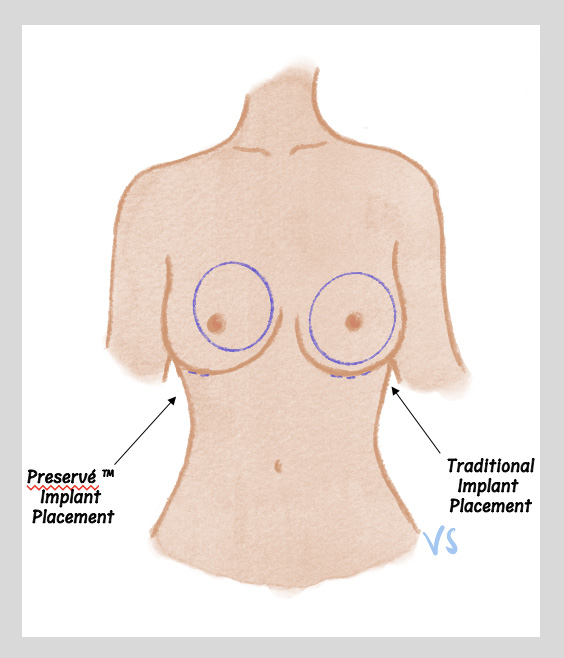
In a traditional breast augmentation, an incision is made within the fold under the breast, and a pocket for the implant is created directly under the breast mound itself, under the surgeon’s direct visualization using sharp surgical tools. Creation of this pocket divides Cooper’s ligaments where the implant sits.
The breast implant is then inserted through the incision and, as illustrated in the left breast below, positioned against the breast fold where the breast itself is widest and most projecting (sticks out farthest from the chest wall). The illustration below shows this on the left breast.
What Are Potential Downsides of Traditional Breast Augmentation?
Creating the Implant Pocket With Sharp Instruments Disrupts Many of the Breast’s Native Structural Ligaments
Creating the implant pocket with sharp instruments, even when done meticulously, not only divides most of the ligaments within the implant pocket but also puts the circummammary ligament at risk. This is particularly true along the side of the chest and along the breast fold where the ligament is weakest.
Damage to this ligament can lead to bottoming out of the implant or other malposition. Think of this like the implant slipping beyond the fenced-in “property” of the breast.
Creating the Implant Pocket With Sharp Instruments Disrupts Many of the Breast’s Sensory Nerves
For the same reason, creating the implant pocket puts many of the breast and nipple’s sensory nerves at risk and can lead to decreased post-operative sensation. These nerves enter along the chest wall and are most at risk of damage in this region along with the circummammary ligament.
Traditional Breast Augmentation Adds the Most Volume Where Most Breast Needs it the Least
A traditional breast augmentation positions the implant under the lower pole of the breast. Because this is where most of the breast volume is concentrated, it is also the most projecting part of the breast (where the breast sticks out furthest from the chest wall).
What if the breast could be augmented in the upper pole, where it lacks volume, and along the edge closest to the breast bone to selectively enhance cleavage? As you will see in the following sections, this is exactly what the Preservé™ technique was designed to accomplish.
The Preservé™ Sequence
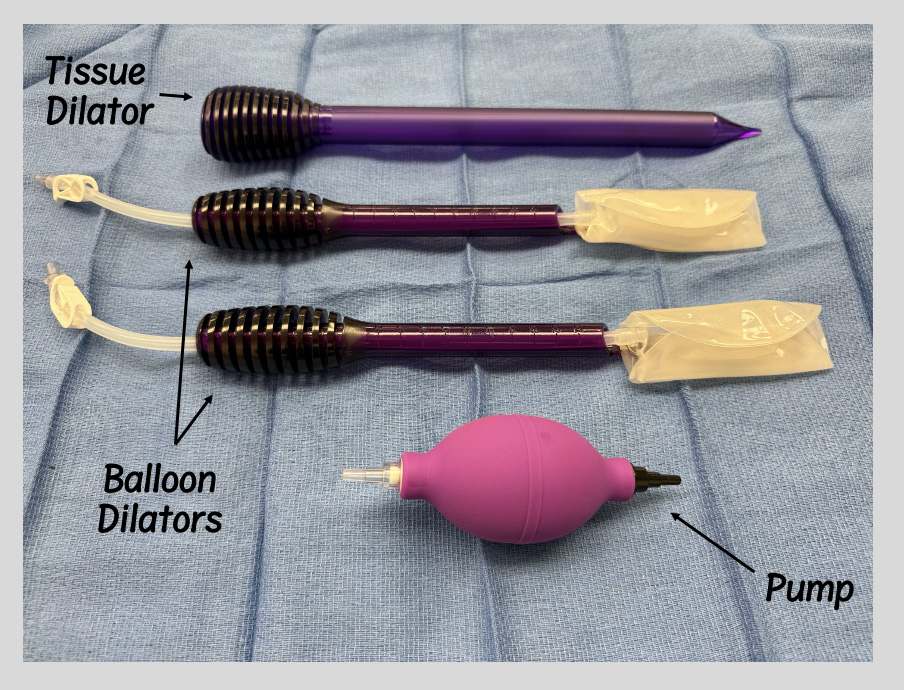
To understand how Preservé™ differs from a traditional breast augmentation, it is best to walk through a typical Preservé™ operative sequence. These steps are illustrated below, but first let’s become familiar with the technique’s specially designed instrumentation.
Each Preservé™ kit comes with:
- A Tissue Dilator: This device creates the tunnel through which the implant is inserted to reach the implant pocket.
- Two Balloon Dilators: These inflatable balloons create the implant pocket through gentle dissection by inflating the balloon. Surrounding tissue, including structural ligaments, blood vessels, and nerves, is spared.
- One Pump: This inflates and deflates the balloon dilators.
To begin the operation, a small incision is made in the breast fold. This incision is typically about 30 percent smaller than the incision required for a traditional breast augmentation. Once this is done,
local anesthesia is infused in the region where the ultimate implant is going to sit. This is often done with ultrasound to confirm the correct tissue plane.
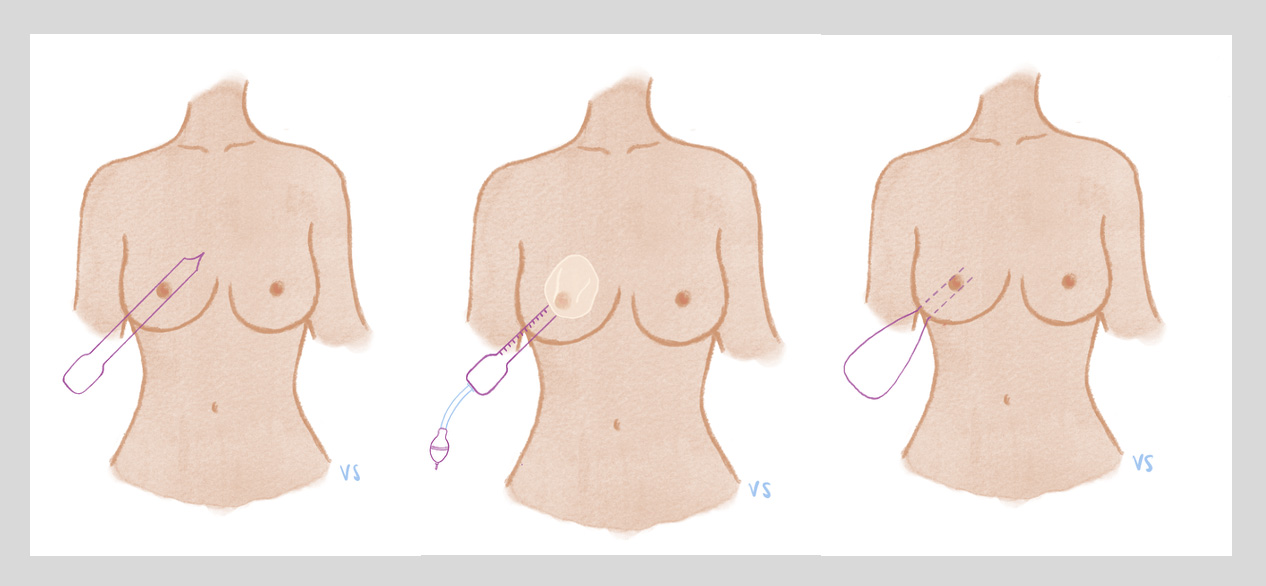
At this point, a series of three maneuvers is performed:
- The tissue dilator is gently inserted through the incision below the breast tissue and just above the chest wall muscles (pectoralis major), creating a small tunnel to the implant pocket site (left, below). All tissue to the sides and beneath the dilator is completely preserved.
- The balloon dilator is then inserted into the implant pocket site and inflated until it matches the volume of the implant to be inserted (center, below). This aero-dissection gently spreads the tissue beneath the breast and above the muscle, preserving the surrounding structural ligaments, nerves, and blood vessels. The balloon is then deflated and removed.
- Finally, the implant is inserted using a special funnel through the small tunnel created by the tissue dilator and into the implant pocket (right, below).
As you can see from the illustration below (exaggerated for illustrative purposes), when the Preservé™ technique is used to place the implant, it sits slightly higher and closer to the midline (Right breast, below). This produces an augmentation of the whole breast, with special emphasis on the upper pole and cleavage region.
Summary: What Are the Benefits of Preservé™?
Now that you understand the differences between a traditional breast augmentation and Preservé™. Hopefully, the advantages of the latter are apparent.
In summary, the Preservé™ technique:
- Preserves the structural Cooper’s and circummammary ligaments of the breast. Doing so maximizes implant stabilitywhile minimizing the risk of implant bottoming out or falling out to the side (malposition). This is illustrated below in the drawing on the left.

- Preserves the breast’s blood supply and sensory nerves, minimizing the risk of sensory changes to the breast skin and nipple/areola.
- Minimizes post-operative restrictions and pain by keeping trauma to the tissue surrounding the implant to a minimum.
- Requires around 30 percent smaller incisions than traditional breast augmentation, with scars beautifully concealed in the breast fold.
- Couples a minimally invasive breast augmentation with use of the most advanced, sixth-generation silicone gel MOTIVA implants to create a balanced, natural augmentation.
- Focuses on nuanced enhancement of the upper pole and cleavage regions while producing a global breast augmentation.
Preservé™ Recovery Timeline
Post-surgical recovery differs from patient to patient and depends on many factors, such as age, overall health, baseline fitness level, and more.
Below is a rough timeline one can expect following Preservé™ breast augmentation.
Day of Surgery
After returning home the day of your surgery, you should plan on being pretty much a couch potato. Expect to be tired. Activities of daily living around the house, such as going to the bathroom, lifting the TV remote, and walking in the house, are permitted and will be well tolerated.
The breasts will feel tight and sore, but discomfort should be easily managed with over-the-counter pain medication such as Tylenol and Ibuprofen. Stronger narcotic or non-narcotic medication may be required as needed for the first 24 to 48 hours.
The upper poles of the breasts will appear swollen and even out of proportion compared to the lower poles.
Week 1
Energy levels will quickly return to normal. Returning to your routine, including all activities around the house, walks outside, lower body workouts, and less intense cardio routines, should be well tolerated.
The breasts will continue to feel tight and sore. Discomfort may continue for the first one to two days post-operatively as swelling peaks. Any discomfort should be well managed with over-the-counter pain medication, though it is not uncommon to be off all pain medication by post-operative days three to five.
Breast swelling will persist and will peak around 48 hours post-operatively. Mild bruising may appear. The upper poles of the breast may continue to increase in size slightly, and the implants may appear to be sitting slightly high on the chest wall.
Weeks 2 to 4
All activities will be well tolerated. You may return to all workout routines as tolerated.
Soreness will completely subside, though some tightness at the extreme range of arm motion is to be expected. Any residual bruising will vanish.
Breast swelling will subside significantly, and the implants will begin to settle into their final location. Upper and lower poles of the breast will appear much more harmonious.
Months 1 to 3
No formal physical activity restrictions, though patients should continue to listen to their bodies and modify activity accordingly
Small twinges of burning, pulling, and stretching may occasionally occur, but no discomfort will be present.
Implants will settle into their final position and upper / lower pole harmony will be permanently established.
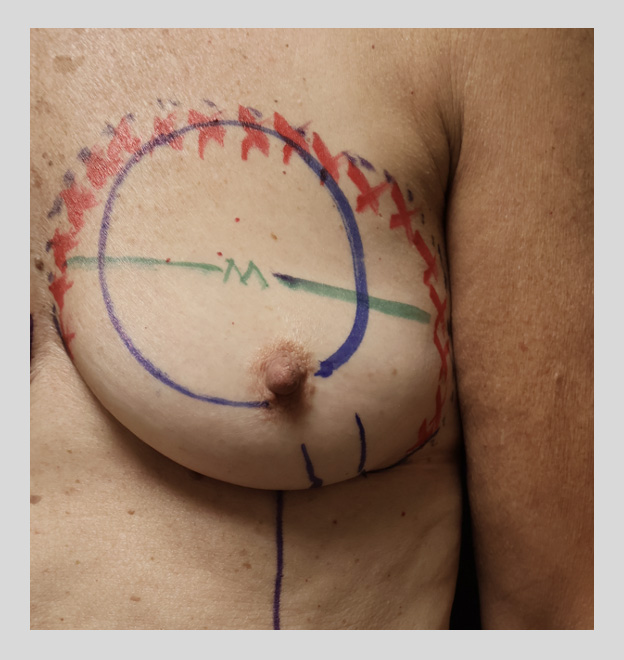
The Consultation
During your initial consultation, Dr. Gougoutas will review your augmentation goals and perform a full medical, surgical, and breast-specific evaluation. You’re encouraged to bring photographic examples you find particularly desirable or undesirable, as a picture is truly worth a thousand words.
Dr. Gougoutas will then perform Bi-dimensional implant planning with you to help you select the implant that gives you the aesthetic you desire. Bi-dimensional planning focuses on several breast characteristics, including:
- Anatomical Measurements
- Tissue evaluation in all quadrants of the breast
- Proportion matching
After synthesizing the above information, Dr. Gougoutas will determine if you are a good candidate for the Preservé™ technique. If so, he will perform implant placement planning, as illustrated below by the blue circle.
Other components of the initial consultation include:
- Anesthesia planning
- Review of the Preservé™ technique
- Review of surgical risks
- Review of recovery timeline
Preservé™ Risks and Safety
There are no risks unique to Preservé™ beyond those of traditional breast augmentation, which are listed below. A comprehensive review of breast implant safety, risks, and factors that may lead to breast implant revision can be found here.
- Capsular contracture: The scar tissue around the implant squeezes down on the implant, leading to hardening, shape changes, and, in severe cases, discomfort. This risk is minimized with the Preservé™ technique.
- Malposition / bottoming out: The implant slowly drifts out from underneath the breast (malposition). When this happens, it will typically happen beneath the breast fold (bottoming out). The Preservé™ technique minimizes this risk.
- Rupture: A hole develops in the implant shell or casing
- Infection: This can range from mild skin inflammation to bacterial contamination of the implant itself necessitating removal
- Hematoma: A blood collection that develops around the implant typically within the first 1-3 days after surgery
- Alterations in nipple-areola complex and/or breast skin sensation: Damage to sensory nerves causing altered breast sensation is generally temporary, but in rare cases, it can be permanent. The Preservé™ technique also minimizes this risk.
- Asymmetry: Native differences in breast size or shape and / or chest wall anatomy may be magnified with breast augmentation
- Poor scarring: Even though breast augmentation incisions are very small, poor scarring can result. Post-operative scar care is critical to minimize this risk. The Preservé™ technique uses a shorter scar, which minimizes the risk.
- Need for revisional surgery: Revisional surgery may be required if any of the above complications are encountered either in the short or long term following surgery.
Preservé™ Cost
Preservé™ requires specialized equipment and training. As a result, this technique costs about 20 percent more than a standard breast augmentation. During your consultation, Dr. Gougoutas will provide you with a more accurate cost estimate based on your anatomy, goals, and unique surgical plan.
1. Do I have to use MOTIVA implants with the Preservé™ technique?
Yes. Only Motiva Ergonomix implants have the unique silicone gel consistency that permits them to be introduced into the breast implant pocket through the narrow, tissue-preserving tunnel.
2. What are the largest implants that can be used with Preservé™
The largest implants that can be placed using the Preservé™ technique are Ergonomix, full-profile, 315cc implants. These implants have a base width of 11cm and a projection of 4.5cm.
3. Do a certain type of MOTIVA implants need to be used with the Preservé™ technique?
Yes. There are two types of Motiva implants: Ergonomix and Round. Ergonomix has a softer, more flexible gel, while Round implants have a firmer, more stable gel. The firmer gel consistency used in Round implants does not allow them to pass through the narrow tissue-preserving tunnel. Therefore, only Ergonomix implants can be used.
4. Are there any surgical risks that are unique to Preservé™?
Preservé™ is generally considered safe with no consistent surgical risks. That said, because the Preservé™ technique is relatively new, long-term data on general implant complications (rupture, capsular contracture, infection, malposition) are limited.
5. How long does a Preservé™ breast augmentation take?
Operative time is approximately 20 to 25 minutes per breast. This time estimate does not include induction of anesthesia, prepping, and dressing time. From the moment a patient enters the operating room until they are wheeled out is approximately an hour and 15 minutes on average.
6. Can implants be placed in different augmentation planes using Preservé™?
No. With the Preservé™ technique, implants can only be placed in the sub-glandular plane (directly beneath the breast tissue, above the muscle).
7. I’ve heard that implants placed in the sub-glandular plane have a higher risk of capsular contracture. How does the Preservé™ technique mitigate this risk?
Preservé™ mitigates this risk by using the latest sixth generation Motiva implants.
Studies show higher rates of capsular contracture when implants are placed in the sub-glandular position compared to the sub-pectoral position. However, those studies are quite old and focused on implants that are several generations removed from today’s fifth- or sixth-generation implants. Motiva implants have a uniquely developed surface designed to minimize capsular contracture rates, and, without getting too technical, there is data to support that claim.
Implant insertion methods have also evolved to minimize implant handling, which is believed to be a key factor in the development of capsular contracture. While long-term data is lacking, it is generally believed that use of Motiva implants in the sub-glandular plane will result in exceedingly low rates of capsular contracture.
8. When can I return to work after my Preservé™ breast augmentation?
This largely depends on your occupation. Patients with desk jobs, who work from home, or otherwise have low-intensity occupations may be able to return to work within two to three days. That being said, surgery makes you tired. Even if you are pain-free, your energy will likely not be 100 percent until at least one week after surgery. For this reason, patients will often opt to take five to seven days off work, as permitted. Patients with higher-intensity jobs, particularly those that require excessive lifting or carrying, should plan on at least 10 days off.
9. When can I lift my child after my Preservé™ breast augmentation?
I generally recommend not lifting more than about 15 to 20 lbs for 10 to 14 days following your procedure. More important than lifting, however, is avoiding applying pressure across the breasts, as this could displace the implants. Lifting your child and resting them on your hip, lap, shoulder, or stomach should be fine within the first week of recovery as long as they don’t weigh more than 15 to 20 lbs.
10. When can I have sex after Preservé™ breast augmentation?
Sexual activity may be resumed immediately as tolerated, though direct pressure on the implants should be avoided for four weeks after surgery.
11. Are there any disadvantages of Preservé™ compared to a traditional breast augmentation?
The biggest disadvantages of Preservé™ are the limitations it places on implant size, consistency, and plane of augmentation, which limits patient candidacy. Conventional breast augmentation permits the use of any implant size and consistency in any anatomic plane, enabling a wider range of aesthetic outcomes.
Because of the specialized equipment and training required, Preservé™ is also more expensive than conventional techniques. As a newer technique, Preservé™ lacks long-term data surrounding complication rates, though early data looks extremely promising.
12. Can I get a breast lift at the same time as Preservé™
While there are surgeons that offer a breast lift at the same time as a Preservé™ breast augmentation (augmentation mastopexy), this is a risky endeavor. Why? Because initially, implants placed with this technique will sit slightly higher and will settle slightly higher than implants placed with conventional techniques. This can make proper nipple positioning very challenging even when only a small lift is needed.
If a larger, more dramatic breast lift is needed, it will almost certainly require extensive skin and breast tissue rearrangement, which negates the advantages of the Preservé™ technique. The bottom line is that the decision to pursue a lift at the time of your Preservé™ augmentation is at your surgeon’s discretion, and an appropriate discussion of additional risks is imperative.
13. If I am an equally good candidate for Preservé™ and a conventional breast augmentation, which should I choose?
There is no right or wrong answer. If your augmentation goals align with the Preservé™ technique and your surgeon deems you a suitable candidate, you have to ask yourself whether the advantages of the technique outweigh the potential downsides.
In my opinion, the biggest “disadvantage” to the technique for a patient who is otherwise a perfect candidate boils down to the lack of data on long-term results. Plastic surgeons who perform this technique widely agree that the technique produces beautiful results, and based on available data, there is no reason to believe these results won’t be as durable as, if not more so than, those of traditional techniques.
14. When can I get back to the gym after Preservé™?
You can return to the gym within the first week following your procedure. However, returning to your gym routine should be approached cautiously and intelligently. It is best to start with lower-body workouts and gradually increase to upper-body workouts during the second week after surgery.
If your workout routine produces significant discomfort, DON’T DO IT. Most patients, however, report being able to return to even the highest-intensity workouts (HIIT) within two weeks following the procedure.
15. Are all plastic surgeons equally qualified to perform Preservé™?
Absolutely not. When choosing a surgeon, it is critical to find one who not only has advanced aesthetic training in plastic surgery, such as a dedicated aesthetic fellowship, but one who has been certified specifically in the Preservé™ technique. As a prospective patient, it is critical to understand your surgeon’s credentials and experience. Beyond that, you must feel comfortable and confident in your surgeon’s ability to not only perform the procedure, but to see you through your entire surgical journey. Be an educated consumer!
16. Can I get fat grafting done at the same time as Preservé™?
Absolutely yes. Fat grafting can make a patient who would not otherwise be a candidate for Preservé™ into an ideal candidate by adding extra volume to help mask implant contours and reduce rippling.
I think of fat grafting like spackling—it subtly blends the transition between implant and native subcutaneous tissue. The use of fat grafting and implants is called a composite breast augmentation and can be an incredibly powerful combination for the right patient.
Learn More About Preservé™ Breast Augmentation In Seattle, WA
Preservé™ is the first of its kind, minimally invasive breast augmentation. This novel technique uses Motiva Ergonomix implants to produce a subtle, natural breast augmentation while preserving the breast’s structural ligaments and sensory nerves.
Dr. Alexander Gougoutas is a board-certified plastic and reconstructive surgeon specializing in aesthetic and reconstructive breast surgery. He has advanced fellowship training in cosmetic surgery and is one of the very few surgeons certified to perform the Motiva Preservé™ technique in the Seattle metropolitan area.
Dr. Gougoutas takes a personal approach to understand what you hope to achieve with your breast augmentation. He will consider implant size, positioning, profile, and whether fat grafting may help refine your results. The goal is to make your breast augmentation complement your natural, existing features while boosting your confidence and feminine silhouette.
To learn more about Preservé™ breast augmentation options in Seattle, WA, schedule a consultation with Dr. Gougoutas by calling (206) 320-6138 or filling out our online contact form today.